

A backyard renovation that truly satisfies everyone in the household is harder to achieve than it sounds. Children and adults use outdoor space differently, want different things from it, and have different definitions of what makes it successful. Designs that optimise entirely for adult preferences produce spaces that children ignore. Designs that centre entirely on children’s needs can feel like a playground rather than a home garden.
The best family backyard renovations find a way to serve both, and understanding how to do that is the difference between a project that delivers genuine long-term satisfaction and one that looks good in photographs but feels like a compromise to live in.
Understanding What Each Household Member Actually Wants
Before any renovation planning begins, it is worth sitting down and being honest about what different people in the household genuinely want from the outdoor space. This conversation is more useful than it might seem, because assumptions about preferences are frequently wrong, and a renovation based on assumed preferences rather than actual ones produces avoidable disappointment.
Children, when asked what they want from a backyard, are usually very specific. They want space to run. They want something to climb. They want somewhere to dig. They want water if it is warm. They want somewhere they can be out of sight of adults occasionally, which is a normal developmental need rather than something to be concerned about. These preferences are consistent across a wide age range and they are almost always achievable within a thoughtful design.
Adults typically want somewhere comfortable to sit. They want visual appeal. They want a space that is not exhausting to maintain. And they want to be able to supervise children without being in constant direct proximity. These priorities do not conflict with children’s preferences. They sit alongside them, and a well-planned renovation addresses both simultaneously.
Creating Visual Coherence Without Sacrificing Function
One of the reasons family backyards often look cluttered or unresolved is that functional additions, the trampoline, the sandpit, the plastic playhouse, have been added over time without any consideration of how they relate to each other or to the rest of the garden. The result is a space that reads as a collection of individual objects rather than a designed outdoor room.
Achieving visual coherence in a family backyard requires treating functional elements as design elements. A sandpit with a timber edge that matches the deck material is the same function as one in a plastic shell but integrates visually in a way the plastic alternative never can. A climbing structure in a consistent colour palette, positioned with awareness of sight lines and the surrounding planting, becomes part of the garden rather than sitting in opposition to it.
This does not require a large budget. It requires intention. Choosing materials that relate to each other, positioning structures in relationship to the boundaries and other elements of the garden, and applying consistent finishes throughout creates coherence without additional cost.
Swing Sets as a Renovation Anchor
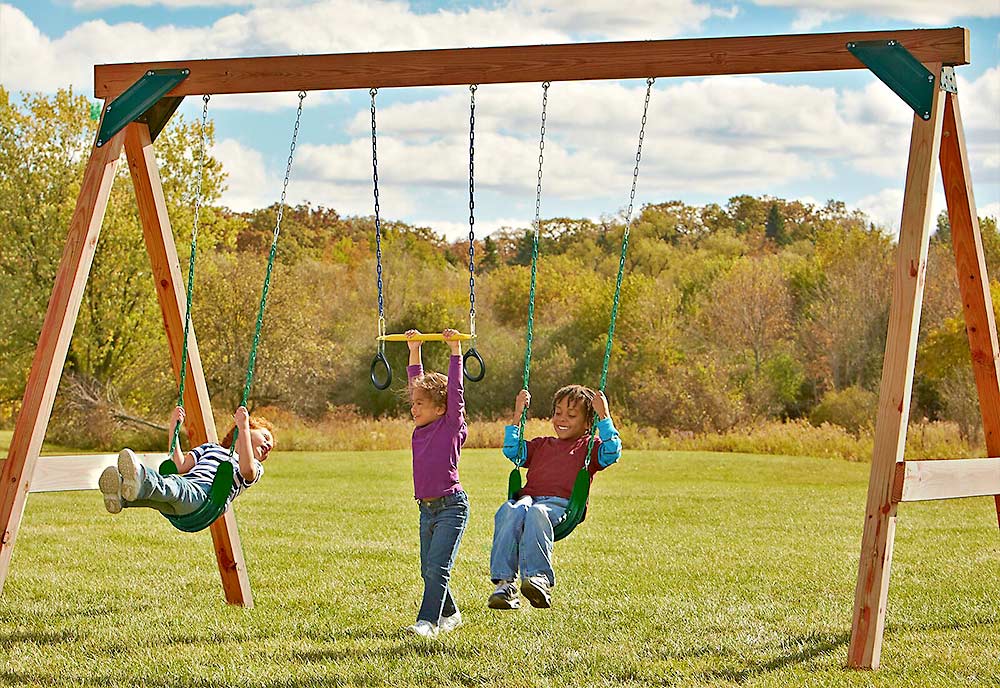
For backyards that are being renovated with children in mind, a quality play structure serves as the anchor around which the rest of the play zone design builds. Getting this choice right is one of the most important decisions in the renovation because it determines the character and scale of the play area for years.
The temptation toward cheaper options that fulfil the brief on paper is understandable in the context of a larger renovation budget, but it is worth resisting. Lightweight, poorly built play equipment looks tired within a single season, develops structural issues that create safety concerns, and ends up being replaced at a cost that exceeds what a quality piece would have cost originally.
Well-built swing sets from dedicated manufacturers use materials and construction methods that hold up to years of heavy use without significant degradation. The difference is visible immediately and it becomes more pronounced over time. A structure that looks as good in its fifth year as it did when installed is a genuine asset to the garden. One that shows its age within two years actively detracts from the space.
Surface Design in the Play Zone
The surface underneath and around play equipment is a safety, maintenance, and aesthetic consideration that deserves more attention than it typically receives. Grass is the most common choice and has genuine advantages: it is soft, natural, and cost-free if it is already present. Its disadvantage is that it deteriorates quickly under heavy play traffic and becomes a mud patch in wet conditions.
Impact-absorbing surfaces installed under play equipment provide better fall protection than grass and remain consistent in quality across all weather conditions. Rubber mulch, engineered wood fibre, and poured rubber surfaces are all options with different aesthetic and maintenance profiles. Rubber mulch is the most affordable and has a natural appearance. Poured rubber is the highest performing option and the most visually clean but at a correspondingly higher cost.
Edging the play zone clearly, with timber, steel, or concrete, gives the surface material containment and defines the boundary between the play area and the rest of the garden. A clearly defined play zone that has been designed as a space rather than simply an area where equipment has been placed looks considerably more considered and integrates better with the surrounding garden.
Entertaining Areas That Work for Adults
While the play zone anchors the children’s experience of the backyard, the entertaining area anchors the adult one. And the most important thing about the entertaining area in a family backyard is that it has a clear sightline to the play zone.
Parents do not want to choose between supervising their children and enjoying the outdoor space themselves. A layout that places the dining and relaxation area in clear view of the play area allows both to happen simultaneously. This is one of the most functional aspects of family backyard design and one that is frequently overlooked in favour of separating the two areas entirely.
Comfortable, durable outdoor furniture in materials that hold up to outdoor exposure without requiring intensive seasonal maintenance makes the entertaining area genuinely usable rather than aspirational. Teak, powder-coated aluminium, and quality all-weather wicker all perform well over time. Cheap furniture that fades, rusts, or deteriorates after a single season is a false economy in any outdoor setting.
Comments are closed.