

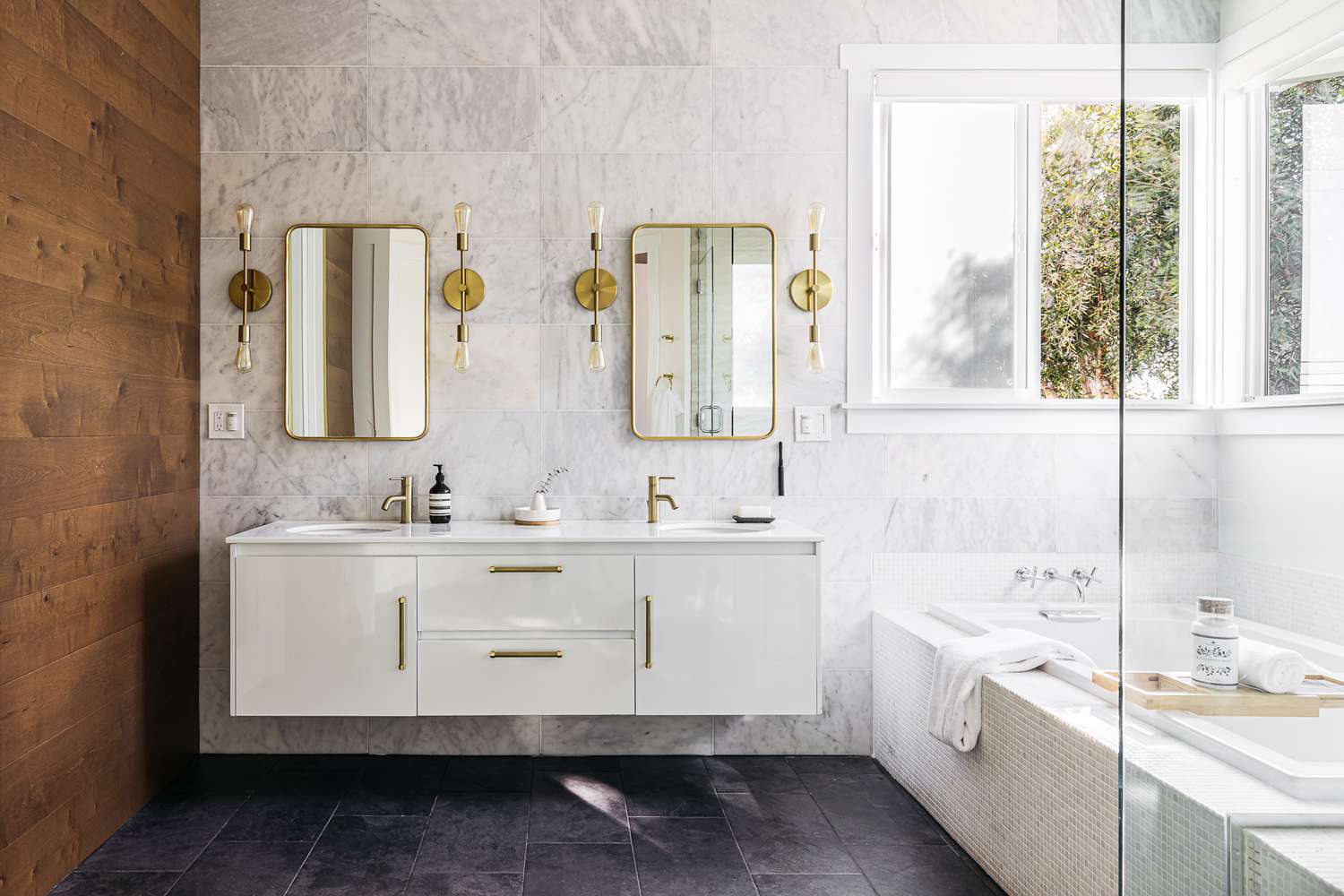
Lighting a master bathroom requires balancing aesthetic atmosphere with high-precision functionality. This space handles varied daily routines, from detailed morning grooming to evening relaxation. A single overhead fixture leaves shadows, creates glare, and degrades both the comfort and functionality of the space. Creating a well-designed master bathroom requires a layered illumination strategy that combines ambient, task, and accent lighting with strict attention to electrical safety standards for wet environments.
The Three Fundamental Layers of Bathroom Lighting
A successful master bathroom lighting design coordinates three distinct layers of light. Balancing these layers eliminates dark corners, renders true skin tones, and creates depth across architectural surfaces.
Task Lighting
Task lighting provides direct, focused illumination to areas where specific activities take place, such as shaving, applying makeup, and brushing teeth.
In a bathroom, the vanity zone represents the core task area. Effective task lighting should illuminate the face evenly from the front rather than from above. Overhead downlights directed straight down onto a countertop project pronounced shadows beneath the eyes, nose, and chin, making daily grooming difficult.
Ambient Lighting
Ambient lighting serves as the primary substitute for natural daylight, supplying the baseline illumination needed to navigate the room comfortably.
This general layer fills the volume of the bathroom and softens contrast between brighter task zones and the rest of the space. Ambient light is commonly delivered through:
-
Flush-mount and semi-flush ceiling fixtures
-
Recessed can lights spaced evenly across the ceiling perimeter
-
Cove lighting positioned along ceiling drops or architectural cornices
-
Natural light entering through frosted windows, skylights, or transoms
Accent Lighting
Accent lighting adds dimension and draws attention to standout architectural details, tile work, or freestanding fixtures.
While not strictly required for everyday utility, accent fixtures transform an ordinary bathroom into an inviting retreat. Common applications include:
-
Recessed directional spotlights aimed at freestanding soaking tubs or textured stone feature walls
-
Under-vanity LED strip lighting that creates a floating appearance while serving as a soft nightlight
-
Backlit mirrors that wash surrounding wall surfaces in a diffuse glow
-
Niche illumination inside dry storage alcoves or open linen shelving
Choosing the Right Fixtures for Every Zone
Selecting fixtures involves evaluating both aesthetic form and optical performance. The fixture style sets the design tone, while the physical construction dictates light dispersion.
Vanity Sconces
Wall-mounted sconces positioned beside a mirror represent the gold standard for vanity lighting. Fixtures with frosted glass, milk glass, or fabric diffusers spread light evenly without harsh glare. Avoid clear glass shades paired with exposed filament bulbs at the vanity, as the bare filament produces intense points of brightness that cause visual fatigue.
Multi-Light Vanity Bars
When wall space beside a mirror is restricted by corner walls, medicine cabinets, or double basins, horizontal vanity bars mounted directly above the mirror offer a practical alternative. Choose fixtures featuring downward-angled or fully diffused shades that cast wide, overlapping beams across the vanity counter rather than a narrow downward pool.
Recessed Ceiling Downlights
Recessed cans provide clean, unobtrusive ambient illumination. When selecting recessed housings for bathrooms, look for:
-
Diffusion lenses: Frosted or prismatic lenses soften the beam and prevent direct line-of-sight glare.
-
Adjustable gimbal trims: Directional trims allow you to angle beams toward shower walls, artwork, or linen storage.
-
Airtight and IC-rated enclosures: Insulated ceiling (IC) ratings allow fixtures to sit in direct contact with ceiling insulation, preventing thermal loss.
Statement Pendants and Chandeliers
Hanging fixtures inject drama into large master bathrooms with tall ceilings. They work best when hung over a clear floor area or as a deliberate focal point above a freestanding tub, provided ceiling clearance meets regional building codes.
Precise Fixture Placement and Dimensions
Correct placement determines whether a fixture performs as intended. Even high-end fixtures will underperform if mounted at the wrong height or angle.
Sconce Positioning at the Vanity
-
Height: Install wall sconces so the center of the light source sits roughly sixty to sixty-five inches above the finished floor. This aligns the light with the average eye level.
-
Spacing: Position sconces twenty-eight to thirty-six inches apart along the wall. This spacing creates cross-illumination that washes the face from both sides, eliminating harsh contours.
-
Mirror coordination: Maintain a minimum distance of three to four inches between the edge of the mirror frame and the edge of the sconce shade to prevent an overcrowded appearance.
Overhead Vanity Bar Placement
-
Mount overhead vanity bars approximately seventy-five to eighty inches above the finished floor.
-
Center the fixture directly above the mirror. The width of the bar should measure roughly seventy to eighty percent of the overall mirror width to ensure balanced proportions.
Recessed Can Layout and Spacing
-
Place recessed cans approximately thirty to thirty-six inches away from walls to wash vertical surfaces without casting scallop patterns.
-
Maintain four to six feet of distance between individual ceiling fixtures, depending on ceiling height and fixture lumen output.
-
Avoid installing recessed cans directly above the standing position at the vanity counter to prevent downward shadows on the face.
Technical Specifications: Lumens, CRI, and Color Temperature
High-quality lighting requires careful attention to electrical and optical specifications.
Color Temperature (Kelvin Scale)
Color temperature describes the warm or cool appearance of white light:
-
2700K (Warm White): Creates an intimate, cozy atmosphere suited for soaking tubs, but can appear overly yellow for precise grooming tasks.
-
3000K to 3500K (Soft White / Neutral): The ideal range for bathroom vanities. It provides clean, crisp illumination that renders skin tones accurately without the clinical sterility of higher color temperatures.
-
4000K and above (Cool White / Daylight): Often feels excessively stark and harsh against warm tile, natural stone, and wood cabinetry.
Color Rendering Index (CRI)
The Color Rendering Index measures how faithfully a light source reveals the true colors of objects compared to natural daylight. In a master bathroom, always specify light sources with a CRI rating of 90 or higher. A high CRI ensures cosmetics, skin tones, and clothing colors appear accurate and natural.
Lumen Output Guidelines
Total lumen requirements depend on bathroom dimensions:
-
Vanity task zones: 1,200 to 1,600 lumens total across all vanity fixtures.
-
Ambient room illumination: Roughly thirty to forty lumens per square foot of room area.
-
Enclosed shower stalls: 400 to 800 lumens from a dedicated ceiling downlight.
Crucial Bathroom Electrical Safety Codes
Water and electricity present severe hazards when combined. National and local electrical codes establish strict safety boundaries for wet and damp spaces.
Understanding Wet vs. Damp Location Ratings
-
Damp-rated fixtures: Designed for spaces subject to moisture, condensation, and steam, but not direct contact with water streams. Suitable for general bathroom ceilings, wall locations outside shower perimeters, and adjacent vanity zones.
-
Wet-rated fixtures: Engineered to withstand direct water spray, splashing, or liquid accumulation. Mandatory for light fixtures mounted inside enclosed showers, directly over open bathtubs within wet boundaries, or on outdoor-adjacent shower walls.
The Bathtub Clearance Zone
Electrical codes enforce a strict exclusion zone around bathtubs:
-
No standard cord-hung pendants, chain-hung chandeliers, or open fixtures may hang within three feet horizontally and eight feet vertically from the top rim of a bathtub.
-
If your ceiling height does not allow eight feet of clearance above the tub rim, you must either omit a hanging fixture or install a recessed, surface-mounted, or wet-rated flush-mount light.
Ground Fault Circuit Interrupter (GFCI) Protection
All bathroom branch circuits and receptacles must incorporate GFCI protection to prevent accidental electric shock. In addition, lighting circuits installed directly inside shower stalls or over tubs must connect to GFCI-protected circuits in accordance with modern building codes.
Frequently Asked Questions
Can smart lighting controls handle high moisture levels in a bathroom?
Smart wall switches and dimmers can be safely used in bathrooms as long as they are installed in standard wall locations outside direct splash zones and wired into grounded, GFCI-protected circuits. However, voice-assistant devices or standard plug-in smart modules with open venting should be kept well away from sink basins, tubs, and damp window ledges.
Is daylight bulb coloring better for applying makeup in the morning?
Extreme daylight bulbs rated at 5000K to 6500K often produce an unnatural blue tint that distorts skin undertones, leading people to apply makeup too heavily. A neutral white color temperature between 3000K and 3500K with a high Color Rendering Index (90 or above) delivers balanced, true-to-life results that translate well to both indoor and outdoor settings.
Why do LED bulbs sometimes flicker in bathroom dimmer switches?
Flickering typically occurs when older magnetic or incandescent dimmers are paired with modern LED fixtures. LEDs require dedicated electronic low-voltage (ELV) or TRIAC dimmers rated specifically for low-wattage solid-state lighting to ensure smooth, hum-free operation across the entire dimming range.
Do walk-in steam showers require different lighting fixtures than standard showers?
Yes. Steam showers generate continuous, penetrating vapor that standard wet-rated shower lights cannot safely handle. Fixtures for steam rooms require specialized marine-grade or vapor-proof certifications with sealed gaskets, non-corrosive trims, and low-voltage transformers to prevent moisture penetration into the electrical housing.
What is the best way to light a separate water closet room?
An enclosed toilet compartment needs minimal yet glare-free illumination. A single centered recessed downlight or an indirect wall sconce producing 400 to 600 lumens at 2700K to 3000K is ideal. Pairing this light with a soft step light or an automatic motion-sensing nightlight helps prevent sleep disruption during midnight visits.
Can natural light from skylights replace dedicated ambient electric lighting?
Skylights and sun tunnels provide exceptional daylight, reduce energy use, and make bathrooms feel larger during peak daytime hours. However, they cannot replace electrical ambient lighting because grooming routines, early mornings, and late evenings require reliable, consistent artificial illumination regardless of outdoor weather or sun position.
How does mirror size influence fixture choices?
Extremely wide mirrors spanning wall to wall often eliminate the side wall space needed for mounting vertical sconces. In these configurations, your options include installing an overhead horizontal bar, hanging sconces directly through cutouts in the mirror glass, or switching to an integrated lighted mirror that houses perimeter LED channels within the frame itself.
Comments are closed.